
Evaluation of Secondary Metabolite Content of CoconutRoot Extract (Cocos nucifera Radix) Through In VitroPhytochemical Screening

Authors

  • Putri Fadila Patilima Universitas Negeri Gorontalo Author
  • Devi Haselia Lamodde Universitas Negeri Gorontalo Author
  • Nurul Izzti Monggesang Universitas Negeri Gorontalo Author
  • Khairunnisa Hasan Universitas Negeri Gorontalo Author
  • Mohamad Adam Mustapa Universitas Negeri Gorontalo Author
  • Wiwit Zuriati Uno Universitas Negeri Gorontalo Author
  • Rifka Anggraini Anggai Universitas Negeri Gorontalo Author

Keywords:

Cocos nucifera Radix, coconut root, maceration, phytochemical screening, secondary metabolites

Abstract

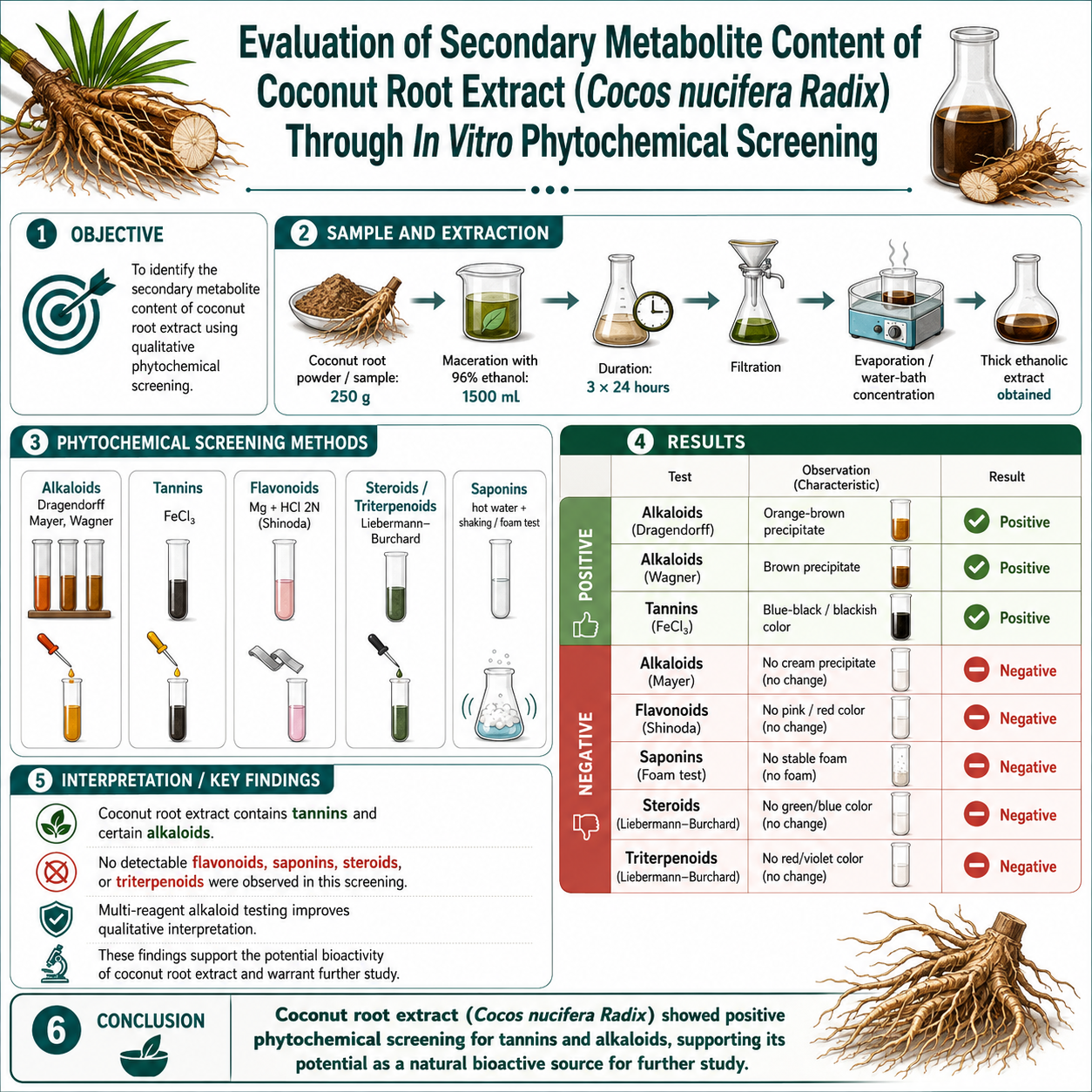
Indonesia has abundant medicinal plant biodiversity that can be developed as raw materials for traditional and modern pharmaceutical preparations. Coconut (Cocos nucifera L.) roots are empirically used in the community, but their active chemical constituents require scientific verification. This study aimed to evaluate the secondary metabolite content of coconut root extract (Cocos nucifera Radix) through in vitro phytochemical screening. Coconut roots were extracted by cold maceration using 96% ethanol. A total of 250 g of coconut root simplicia was macerated with 1500 mL of solvent for 3 x 24 hours, followed by filtration and solvent evaporation to obtain a concentrated extract. Qualitative phytochemical screening was performed using specific reagents, including Dragendorff, Mayer, and Wagner tests for alkaloids, FeCl3 for tannins, magnesium-HCl for flavonoids, foam test for saponins, and Liebermann-Burchard reaction for steroids and triterpenoids. The extract showed positive results for tannins and alkaloids based on Dragendorff and Wagner tests, characterized by blackish coloration and brown precipitate formation. Negative results were obtained for alkaloids using Mayer reagent, saponins, flavonoids, steroids, and triterpenoids. These findings indicate that coconut root extract contains tannin and certain alkaloid compounds, while other tested secondary metabolite groups were not detected under the applied qualitative conditions. Further quantitative and bioactivity studies are recommended to confirm its pharmacological potential.

Downloads
Download data is not yet available.

Author Biographies

  • Putri Fadila Patilima, Universitas Negeri Gorontalo

    Department of Pharmacy, Faculty of Sports and Health, Universitas Negeri Gorontalo, Jl. Jenderal Sudirman No. 06, Gorontalo City 96128, Indonesia

  • Devi Haselia Lamodde, Universitas Negeri Gorontalo

    Department of Pharmacy, Faculty of Sports and Health, Universitas Negeri Gorontalo, Jl. Jenderal Sudirman No. 06, Gorontalo City 96128, Indonesia

  • Nurul Izzti Monggesang, Universitas Negeri Gorontalo

    Department of Pharmacy, Faculty of Sports and Health, Universitas Negeri Gorontalo, Jl. Jenderal Sudirman No. 06, Gorontalo City 96128, Indonesia

  • Khairunnisa Hasan, Universitas Negeri Gorontalo

    Department of Pharmacy, Faculty of Sports and Health, Universitas Negeri Gorontalo, Jl. Jenderal Sudirman No. 06, Gorontalo City 96128, Indonesia

  • Mohamad Adam Mustapa, Universitas Negeri Gorontalo

    Department of Pharmacy, Faculty of Sports and Health, Universitas Negeri Gorontalo, Jl. Jenderal Sudirman No. 06, Gorontalo City 96128, Indonesia

  • Wiwit Zuriati Uno, Universitas Negeri Gorontalo

    Department of Pharmacy, Faculty of Sports and Health, Universitas Negeri Gorontalo, Jl. Jenderal Sudirman No. 06, Gorontalo City 96128, Indonesia

  • Rifka Anggraini Anggai, Universitas Negeri Gorontalo

    Department of Pharmacy, Faculty of Sports and Health, Universitas Negeri Gorontalo, Jl. Jenderal Sudirman No. 06, Gorontalo City 96128, Indonesia

Downloads

Published

2026-07-06

Most read articles by the same author(s)

Similar Articles

You may also start an advanced similarity search for this article.