
Formulation and Quality Evaluation of Conventional Chlorpropamide Tablets Using the Wet Granulation Method

Authors

  • Allail Huljanah Alipu Universitas Negeri Gorontalo Author
  • Aisya Diastuty Bumulo Universitas Negeri Gorontalo Author
  • Devi Haselia Lamodde Universitas Negeri Gorontalo Author
  • Awalia Mawaddah Universitas Negeri Gorontalo Author
  • Nana Nurindah Upara Universitas Negeri Gorontalo Author
  • Nurain Thomas Universitas Negeri Gorontalo Author
  • Robert Tungadi Universitas Negeri Gorontalo Author
  • Multiani S Latif Universitas Negeri Gorontalo Author
  • Lisa Efriani Puluhulawa Universitas Negeri Gorontalo Author

Keywords:

chlorpropamide, conventional tablets, formulation, quality evaluation, solid dosage form

Abstract

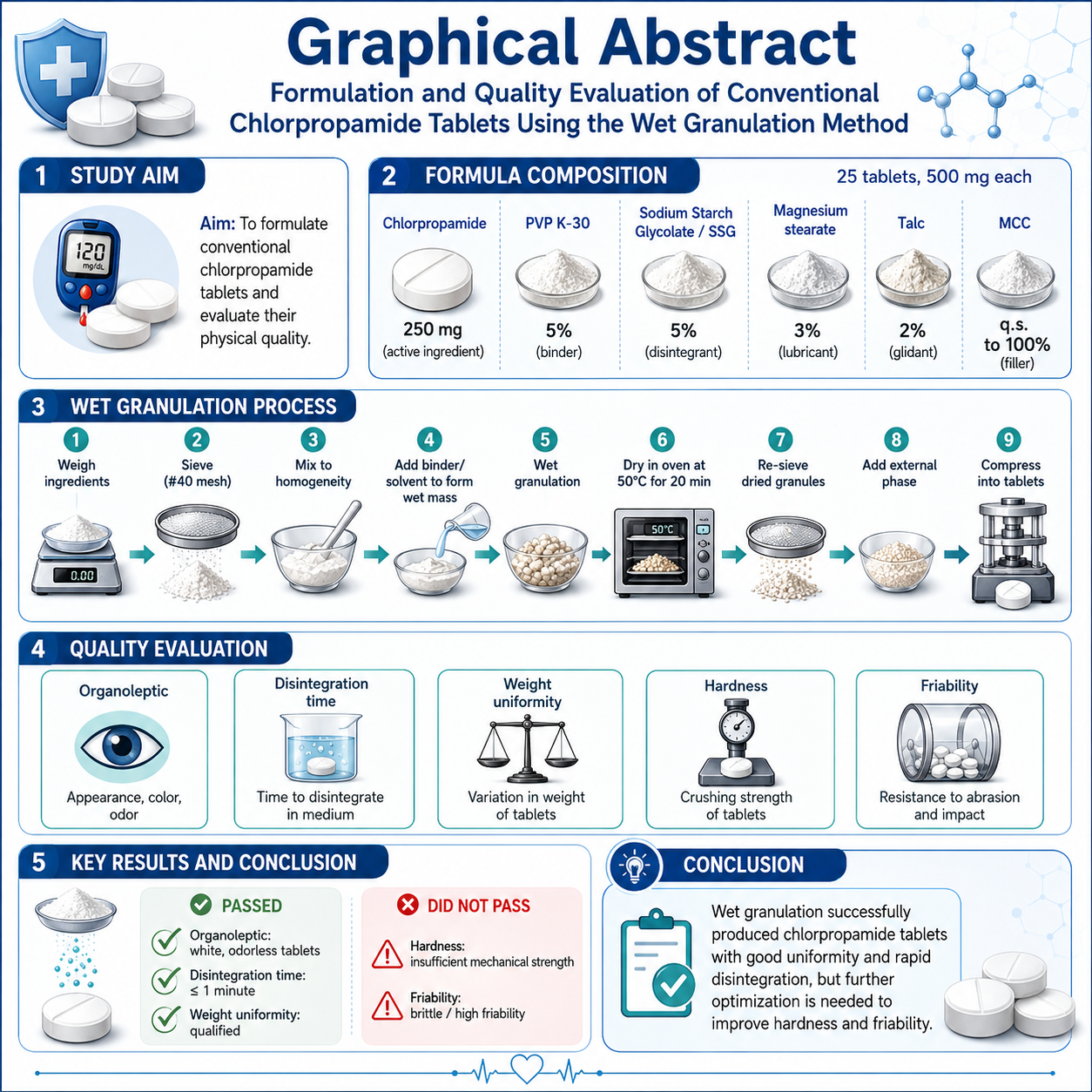
Tablets are solid dosage forms containing active ingredients with or without excipients and are manufactured through compression or molding processes. Conventional tablets are among the most widely used dosage forms because their manufacturing process is relatively simple and they provide rapid release of the active substance after administration. This study aimed to formulate and evaluate the quality of conventional tablets containing chlorpropamide using the wet granulation method. Chlorpropamide was used as the active pharmaceutical ingredient, while microcrystalline cellulose (MCC), Sodium Starch Glycolate (SSG), PVP K-30, magnesium stearate, and talc were used as excipients. Each tablet was formulated to contain 250 mg chlorpropamide, 5% PVP K-30, 5% SSG, 3% magnesium stearate, 2% talc, and MCC q.s. to 100%. The manufacturing process included weighing, sieving through a 40-mesh sieve, mixing until homogeneous, wet granulation, oven drying, resieving, compression, evaluation, and packaging. Quality evaluation was performed through organoleptic testing, disintegration time testing, weight uniformity testing, hardness testing, and friability testing. The resulting tablets were round, white, odorless, and had a characteristic bitter taste. The tablets met the requirements for weight uniformity and disintegration time, with disintegration occurring within the pharmacopeial limit. However, the tablets did not meet the requirements for hardness and friability, indicating insufficient mechanical strength. Overall, the wet granulation method produced conventional chlorpropamide tablets with acceptable weight uniformity and disintegration properties, but further optimization of binder distribution, granule moisture content, and compression force is required to improve tablet hardness and friability.

Downloads
Download data is not yet available.

Author Biographies

  • Allail Huljanah Alipu, Universitas Negeri Gorontalo

    Department of Pharmacy, Faculty of Sports and Health, Universitas Negeri Gorontalo, Jl. Jenderal Sudirman No. 06, Gorontalo City 96128, Indonesia

  • Aisya Diastuty Bumulo, Universitas Negeri Gorontalo

    Department of Pharmacy, Faculty of Sports and Health, Universitas Negeri Gorontalo, Jl. Jenderal Sudirman No. 06, Gorontalo City 96128, Indonesia

  • Devi Haselia Lamodde, Universitas Negeri Gorontalo

    Department of Pharmacy, Faculty of Sports and Health, Universitas Negeri Gorontalo, Jl. Jenderal Sudirman No. 06, Gorontalo City 96128, Indonesia

  • Awalia Mawaddah, Universitas Negeri Gorontalo

    Department of Pharmacy, Faculty of Sports and Health, Universitas Negeri Gorontalo, Jl. Jenderal Sudirman No. 06, Gorontalo City 96128, Indonesia

  • Nana Nurindah Upara, Universitas Negeri Gorontalo

    Department of Pharmacy, Faculty of Sports and Health, Universitas Negeri Gorontalo, Jl. Jenderal Sudirman No. 06, Gorontalo City 96128, Indonesia

  • Nurain Thomas, Universitas Negeri Gorontalo

    Department of Pharmacy, Faculty of Sports and Health, Universitas Negeri Gorontalo, Jl. Jenderal Sudirman No. 06, Gorontalo City 96128, Indonesia

  • Robert Tungadi, Universitas Negeri Gorontalo

    Department of Pharmacy, Faculty of Sports and Health, Universitas Negeri Gorontalo, Jl. Jenderal Sudirman No. 06, Gorontalo City 96128, Indonesia

  • Multiani S Latif, Universitas Negeri Gorontalo

    Department of Pharmacy, Faculty of Sports and Health, Universitas Negeri Gorontalo, Jl. Jenderal Sudirman No. 06, Gorontalo City 96128, Indonesia

  • Lisa Efriani Puluhulawa, Universitas Negeri Gorontalo

    Department of Pharmacy, Faculty of Sports and Health, Universitas Negeri Gorontalo, Jl. Jenderal Sudirman No. 06, Gorontalo City 96128, Indonesia

Downloads

Published

2026-07-06

Most read articles by the same author(s)

Similar Articles

You may also start an advanced similarity search for this article.