
The Effect of Temperature on Water Surface Tension Through Cohesion and Adhesion Forces and the Role of Liquid Molecular Interactions

Authors

  • Faras Esta Lamaga Universitas Negeri Gorontalo Author
  • Ni Putu Nabila Universitas Negeri Gorontalo Author
  • Siti Mutia Pado Universitas Negeri Gorontalo Author
  • Nur Indah Kohongia Universitas Negeri Gorontalo Author
  • Nurain Thomas Universitas Negeri Gorontalo Author
  • Mohamad Aprianto Paneo Universitas Negeri Gorontalo Author
  • Faradila Ratu Cindana Mo'o Universitas Negeri Gorontalo Author
  • Maribby Zuhriah Thalib Universitas Negeri Gorontalo Author

Keywords:

surface tension, capillary rise, cohesion-adhesion, temperature, pharmaceutical formulation

Abstract

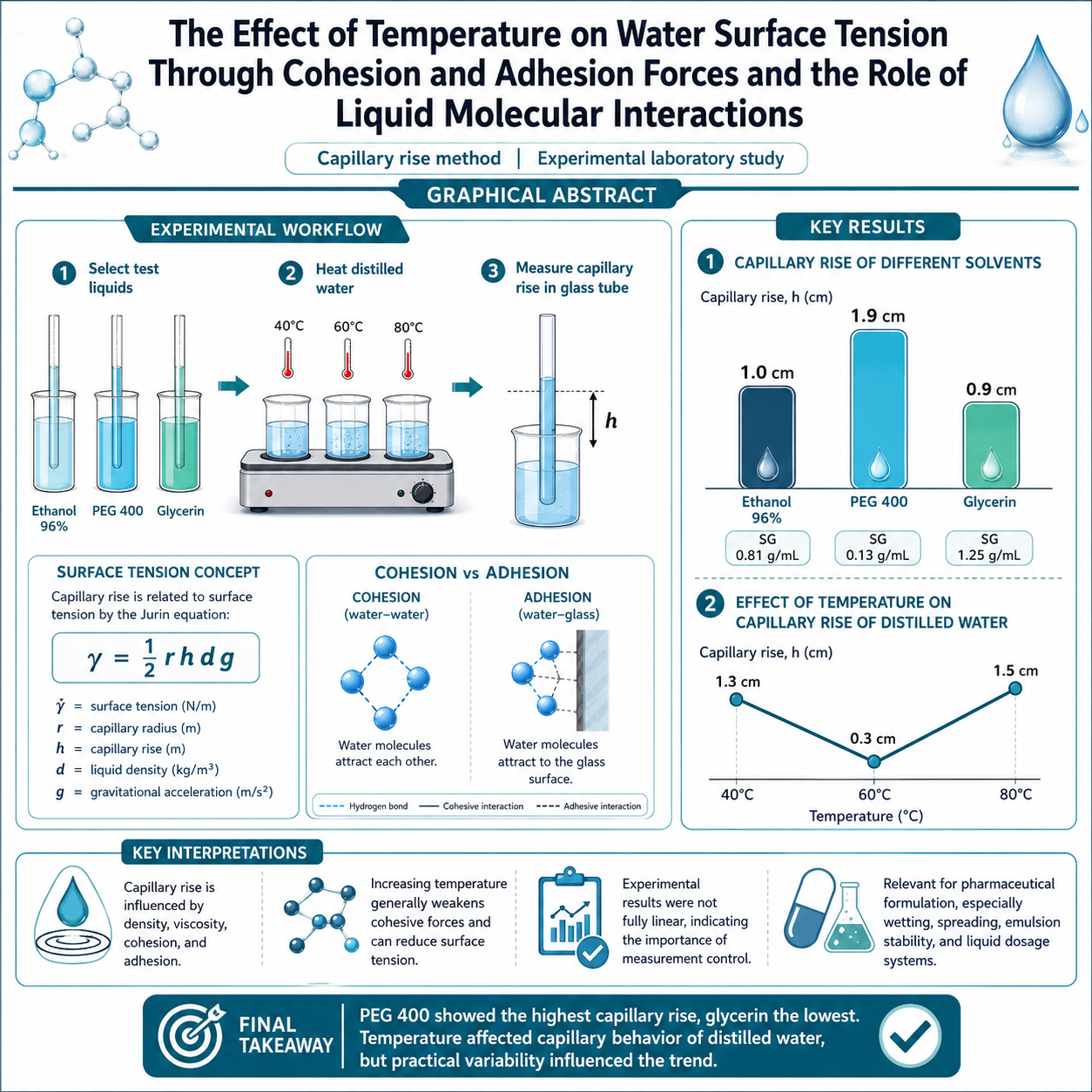
Surface tension is a physical property of liquids that is important in daily phenomena, scientific analysis, and pharmaceutical formulation. This study aimed to evaluate the capillary rise and surface tension behavior of 96% ethanol, polyethylene glycol (PEG) 400, and glycerin, and to observe the effect of temperature on distilled water using the capillary rise method. The laboratory experiment was conducted at the Pharmaceutical Technology Laboratory, Department of Pharmacy, Faculty of Sports and Health, Universitas Negeri Gorontalo. Measurements included specific gravity and capillary rise of each liquid, while distilled water was heated to 40°C, 60°C, and 80°C before observation. The solvent test showed that PEG 400 produced the highest capillary rise (1.9 cm), followed by 96% ethanol (1.0 cm) and glycerin (0.9 cm). The temperature test showed capillary rise values of 1.3 cm, 0.3 cm, and 1.5 cm at 40°C, 60°C, and 80°C, respectively, indicating that the relationship was not fully linear under the practical conditions. These findings confirm that capillary phenomena are influenced by density, viscosity, cohesion, adhesion, and experimental control. The results provide practical information for understanding liquid behavior relevant to pharmaceutical dosage-form development.

Downloads
Download data is not yet available.

Author Biographies

  • Faras Esta Lamaga, Universitas Negeri Gorontalo

    Department of Pharmacy, Faculty of Sports and Health, Universitas Negeri Gorontalo, Jl. Jenderal Sudirman No. 06, Gorontalo City 96128, Indonesia

  • Ni Putu Nabila, Universitas Negeri Gorontalo

    Department of Pharmacy, Faculty of Sports and Health, Universitas Negeri Gorontalo, Jl. Jenderal Sudirman No. 06, Gorontalo City 96128, Indonesia

  • Siti Mutia Pado, Universitas Negeri Gorontalo

    Department of Pharmacy, Faculty of Sports and Health, Universitas Negeri Gorontalo, Jl. Jenderal Sudirman No. 06, Gorontalo City 96128, Indonesia

  • Nur Indah Kohongia, Universitas Negeri Gorontalo

    Department of Pharmacy, Faculty of Sports and Health, Universitas Negeri Gorontalo, Jl. Jenderal Sudirman No. 06, Gorontalo City 96128, Indonesia

  • Nurain Thomas, Universitas Negeri Gorontalo

    Department of Pharmacy, Faculty of Sports and Health, Universitas Negeri Gorontalo, Jl. Jenderal Sudirman No. 06, Gorontalo City 96128, Indonesia

  • Mohamad Aprianto Paneo, Universitas Negeri Gorontalo

    Department of Pharmacy, Faculty of Sports and Health, Universitas Negeri Gorontalo, Jl. Jenderal Sudirman No. 06, Gorontalo City 96128, Indonesia

  • Faradila Ratu Cindana Mo'o, Universitas Negeri Gorontalo

    Department of Pharmacy, Faculty of Sports and Health, Universitas Negeri Gorontalo, Jl. Jenderal Sudirman No. 06, Gorontalo City 96128, Indonesia

  • Maribby Zuhriah Thalib, Universitas Negeri Gorontalo

    Department of Pharmacy, Faculty of Sports and Health, Universitas Negeri Gorontalo, Jl. Jenderal Sudirman No. 06, Gorontalo City 96128, Indonesia

Downloads

Published

2026-07-06

Most read articles by the same author(s)

Similar Articles

You may also start an advanced similarity search for this article.